
miscellanea
|
Cayo Guillermo to Caibarien<< Playa Guaney to Cayo Guillermo | Cuba2003 | Caibarien to Isabela De Sagua >> 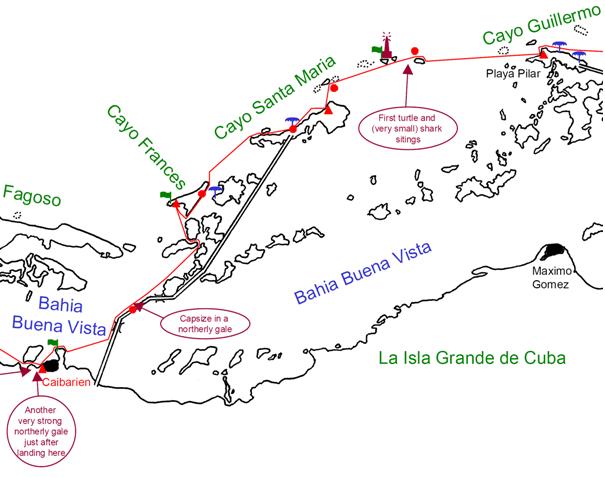 29 April. This day started and stayed calm, to our delight as this was the biggest exposed, offshore crossing of the trip. Had it been rough, we could have circled inland though the inner line of mangrove islands, but it would have been both less scenic and much further. The northern extremity of that inner crescent of islands was two miles offshore, so the main decision for the crossing was when we got there. All was looking good in the sky so we paddled in the azure blue ocean toward the convenient beacon of the lighthouse on the appropriately named Cayo Caiman del Faro. We passed close in between a couple of large fishing boats with manned dinghies fishing between them. We headed towards the dinghies and thus between the boats both because they were on our route, and to have a look. Too late we realised that the large boats had a trawl slung between them, the dinghies being hooked up to the hawser. By the time we realised this there was no escape. Luckily our kayaks could slide easily over the rope between the floats, so they did not catch us. We stopped on the outside point of the first island in the Caimanes group, a blisteringly hot beach in the midday sun, the sky still clear, blue and calm. Then, we island hopped down the chain. Pausing between islands in the clear, calm sea, Alison saw her first turtle (I missed it), and we both saw our first and last shark of the trip, a small one circling gracefully beneath us. We stopped to talk to the Guardia Frontera at the lighthouse, sitting in the kayak holding onto the pier support while they sat on the jetty edge, yards above me. At the western island of the group we stopped again, finding some shade from the still baking sun tucked into spiky rock and prickly scrub. A large iguana came to check us out. All of a sudden the wind started to rise from the north-east, so we quickly jumped in the boats and took the shortest route to the large island of Cayo Santa Maria, our destination for the night, before the wind strengthened further. The wind did rise further if not dangerously so, and we pulled in to the nearest, north-east end of the narrow sandy beach that seemed to stretch all the way south-west to the tourist buildings we could see the outline of in the distance. We had enough water and food so we decided to camp there for the night. I walked back to look at a construction we had seen, which appeared on inspection to be the remains of an old Guardia Frontera post. 30 April. In the morning we battled with ferocious no-see-ums (jejen) while making coffee and striking the tent, and were soon glad to be paddling outside insect range of shore. We paddled into the tourist resort and pulled in to see if we could find our Rombos escort, and to get water and food. Along the walkway from beach to hotel we saw our first hummingbird or zumzum. One of the junior managers looked after us, dosing us with strong coffee and giving us a guided tour of the hotel, an all inclusive package tour destination primarily for Canadians, who spent a week there and went home again without seeing any of Cuba proper. Buying water was easy if expensive, but buying food was trickier because they were set up for the all-inclusive trade: a lot of time, negotiating and paperwork was required before we could buy an expensive packed lunch. But eventually all was sorted out and we paddled off with a few days’ supplies. From Cayo Santa Maria we paddled along the coast to the western tip, past another Guard Frontera post, and as the weather was calm took the relatively short open crossing to Cayo Frances, passing a couple of snorkellers on an offshore reef. On Cayo Frances we rested at a lovely cove, but we weren’t the only ones to find it so, as a tourist boat full of snorkellers turned up, had their obligatory twenty minute snorkelling experience, and pottered on. Opposite us on the neighbouring cayo was another huge tourist complex. We had hoped to camp on the southern tip of Cayo Frances but that proved impossible as it was pure mangroves, so we paddled to the north-west tip close to the Guardia Frontera post, pulling up close to the remains of an old jetty. An old hulk was moored in the bay, with a fishing boat alongside. We later heard claim that the hulk used to have been used as a Rombos restaurant, but were never sure whether than was true or just the Rombos crew pulling our legs, as they were want to do. We set up camp, announced ourselves to the guards who had been eyeing us through their tower-top binoculars, and had a look around. Someone had painstakingly bordered the road with rocks, but is still lead nowhere: the guard post must be resupplied by sea. We soon found out how, as the fishing boat that had been moored to the hulk sailed over and tied up to the relic of a jetty. This was remarkable as the risk of the falling tide dropping the boat onto the jagged jetty remains looked extreme. We went over to help them pull alongside and say hello. Soon we were being shown around the boat by the proud captain and his mate. The men of the Guardia Frontera came aboard also, and soon the domino set was out and the game heated up. The captain invited us for dinner, the ubiquitous and delicious black beans and rice with fish, just for us, which despite our protests meant pushing the guards off their dominoes table. I produced the rum, which crew and guards weren’t allowed, but the captain and mate drank with gusto once I’d convince them that the label on the water bottle container was a lie. For about an hour after dusk the mosquitoes were terrible, but then disappeared as rapidly as they came. Again we had the luxury of insect repellent, but the locals just took the onslaught unprotected. We were treated to a shower on boat, given advice on routes as we pored over the maps and charts, and given a small wooden fishing reel, perfect for the kayak. That was a wonderful night of camaraderie, and we returned to our tent well content. 1 May. The morning was grey but calm and we waved adios at the fisherman and headed south through the mangrove channels back towards the mainland and our next port of call, the large town of Caibarien. We emerged from the mangrove channels and started following the causeway close in, to shelter from the easterly wind. All of a sudden the wind swung around and gathered strength, and soon was blowing a full gale from the west, straight on to us. Had we realised what was to happen, and how quickly, with the first swing of the wind we could have headed back to the last causeway bridge for shelter, but we didn’t and tried to fight into the wind to the next bridge. There had been no warning signs in the clouds that I could see: they looked identical east and west. Just an abrupt change of wind direction then strength. Alison was not strong enough to make headway, and we were so close to the causeway we were at risk of being blown into it, damaging the boats. While I was arranging the towline I pulled Alison side-on to the wind and she capsized. I landed on the causeway, quickly unloaded my boat (losing the rum bottle in the process), hauled it up and secured it, and went back to help Alison do the same. Her water bottles kept in the cockpit had disappeared, but otherwise everything accounted for as we sat on the causeway shivering in the cold wind, excepting my small New Zealand flag mounted on the back of the kayak, that unfortunately had been snapped off and lost. Luckily, its companion Cuban flag survived. (Thinking about this incident afterwards, the water was only a few feet deep and what we should have done is simply got out of the boats in the water and held them until the storm abated. However all my kayaking experience has never included such a shallow-water rescue technique!). The wind backed off as fast as it had come, and was soon a warm but very gusty wind from the east again. We launched, scoured the causeway for and luckily found the water bottles, and headed off, keeping a very watchful and respectful eye on the wind, and sticking close to the causeway. We rounded the point towards Caibarien, talking to a fisherman who was out on a makeshift raft of packing crate and rubber tube. Around the corner we pulled behind the patrol boat to the Guardia Frontera post, where we got eaten by no-see-ums on the beach while the pleasant officer checked our papers and worked out what to do with us, and a row of guards sat along the jetty for the entertainment. Eventually we were sorted, and the officer told us to paddle to the small boat port on the far side of town, where we would be expected. The operator of the small boat port swung the wooden gate open for us, but there was nowhere inside to land a kayak easily, so we paddled back out to the neighbouring sliver of a muddy beach and carried our boats in. We put our kayaks and gear in the open, roofed seating area of small, closed cafe, when to our disbelief two men marched around the corner, one in waiter's uniform carrying a sliver tray with a bottle of rum and coke in an urn of ice. It was our new Rombos escort putting on a superb and humorous welcoming show, as we sat down to a fine and welcome Rom de Cuba. Just then the skies darkened and a fresh cold Northerly blew in hard from the west. We had landed just in time: our third Northerly front, akin to the one that had caused a capsize when it caught us at sea. Rombos took us out to dinner that night, in the pouring rain, travelling in their tiny three-wheeler truck, via a garage to buy some supplies. Caibarien by night looks enticing, the long shadows of old Spanish colonial colonnades, and the fleeting shadows of people going about their business in the warm tropical night. The Rombos restaurant in Caibarien was superb, sited in an ancient, crumbling mansion with half the roof missing. The kitchen and bar area were below the remaining roof along one side, while the rest of the area was dining al fresco between the massive columns and their entwining vines. Chicken, chips and beer were relished by all. This storm lasted hours, much longer at full intensity than the one that caught us on the water, but by the time we returned to the small boat port the storm had largely blown through. << Playa Guaney to Cayo Guillermo | Cuba2003 | Caibarien to Isabela De Sagua >> |


