
miscellanea
|
Playa el Salto y Ganuza to Varadero<< Isabela De Sagua to Playa el Salto y Ganuza | Cuba2003 | >> 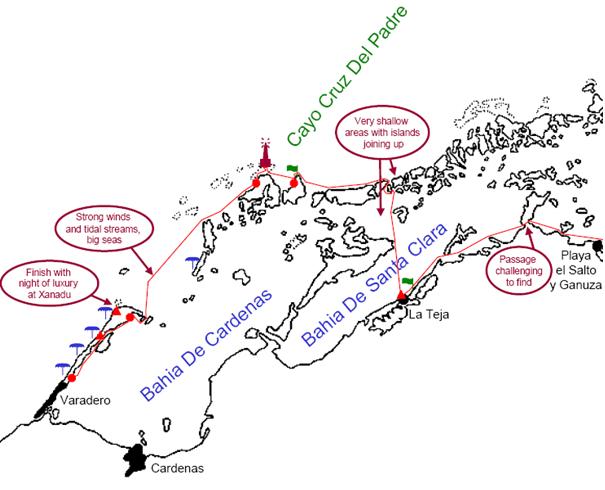 5 May. I left Playa La Panchita early and carried on up the coast, past the small flotilla of fishing boats moored on a secure jetty. I passed inland of one island and found the channel blocked by a line of mangroves growing in an almost perfectly straight line across the channel, but just managed to squeeze the trusty boat through the least shallow gap. A few hours’ paddle and I had reached the next mangrove neck, between Playa el Salto y Ganuza and La Teja, hoping to find a passage to avoid the extra miles of paddling around it, plus of course the navigational challenge of finding a route through. There was no channel, so I wandered into the mangrove maze looking for a way through. I soon find myself in shallow water surrounded by impenetrable clusters of mangroves. I continued edging through, here left a little, there right, nudging my boat forward in the inches of water. Finally I found the tiniest of currents heading west, and wove through yet more mangroves until the next bay opened out in front of me. I felt total exhilarated at this navigational success, out of all proportion to the few miles saved! It's rising to the challenge that's so satisfying. I waved to a couple of fisherman wading in the reeds, and continued west. The large building on the horizon turned out not to be La Teja as I had assumed, but a mill unmarked on my map. I carried on a couple of miles along the coast, pulling in close to the Guard Frontera post: they were expecting me, and pointed me towards La Teja itself, where Alison and her Rombos escort awaited. I had told Alison days before that I expected La Teja to be a wonderful place. It was a feeling I had from its location on the map, tucked between lagoons a long way from anywhere. Or, perhaps, wishful thinking as it was the last remote overnight stop before the tourist complexes of Varadero. But whatever the reason, the feeling was right. La Teja was a wonderful place, nothing but a small group of buildings at the road end, a couple of abandoned houses, and two dilapidated but charming boatsheds jutting over the inside lagoon. The group of buildings turned out to be abandoned but for a few rooms, which were occupied by a proprietor, his smiling face creased and lined by the sun. To our delight he was not only quiet charming but also sold beer, and even some processed meat. We bought both, plus a beer for him, and I was soon having a siesta in the shade alongside my boat. Later the proprietor showed us around his establishment. In one lovely, solid shed he proudly showed us, resting of the rafters above our head, a fine rowing skiff. He took us on a tour looking for the coconut crabs too, but despite the area being covered in their burrows, we caught little glimpse but the odd eye looking out from them, or the huge claw protecting them. 6 May. From La Teja we had planned to continue along the coast for a final crossing to Varadero peninsula. However it was the last full day's paddle, the weather was looking promising, and I was on my own, so decided to take the longer more exposed route, heading due north to the open sea, then along the outer coast. I headed north to a grey, calm dawn, continually refining my precise route as what appeared to be gaps at the end of the island in front turned out to have been closed by new mangrove growth. Twice I slipped through with barely a whisker's room. The whole western end of the archipelago appeared to be closing in, and I was sure that I would be not only the first but also the last kayaker through many of those channels. Approaching the outer fringe of cayos, I was again continuously frustrated by the shallows and new mangrove growth, that kept me hundreds of yards off the old-growth mangroves and so away from any channel that might lie between them. I was continually heading into the cayos, getting caught in the shallows, and heading back out into deeper water to try again a little further west. Then, to my delight, I saw a boat half a mile in front of me, heading north east. I raced towards its route as fast as I could, to avoid losing it and to indulge in my favourite pastime of surfing on fishing boats’ wakes. I was not fast enough to catch up with the boat, but suddenly the water beneath me turned from the green-brown of the shallow lagoons to a beautiful deep, clear blue, and I slid into the deep water of the channel. Free at last from the encroaching mangroves, I followed the channel to sea. I was inside the fringe reef so there were no large swells, but the wind was slowly starting to rise as the day heated up. I followed close to shore, mostly low scrub and shady trees, pleased to be back in the translucent, turquoise waters of the open coast. The wind rose further and I soon found myself surfing between the north point of Cayo Galinda and its offshore reef, underneath the machine-gun post of the Guardia Frontera. I thought it wise to pull in to the small, sheltered bay to say hello to the officer in charge, who waved me off, telling me proudly of the new tourist complex being built on the Cayos Blancos, ten miles further on. I was torn between my preference for nature and my thirst for a beer. Off the tip of the next island was the historic lighthouse of Cayo Cruz del Padre, that understandably features in many Cuban guides. It is a classically proportioned, solid square building, emerging straight from the sea. I circled it despite the rising winds, before heading around the point. From here, the cayos changed direction, so that I was no longer paddling northwest, but south west, and so heading straight towards Varadero, although I could not see it yet behind the isles of Cayos Blancos. I stopped on the beach for a rest, and to enjoy the solitude before rejoining western civilisation. Off Punta Cabeza de Cayo Blanco I could see the buildings of the peninsula of Varedero shimmering ten miles in the distance, and between me and it the most beautiful, empty expanse of azure sea. To the left, the vast new glistening white tourist complex of Cayos Blancos, with glistening white tourist catamarans moored offshore. I chose the empty expanse of azure sea, and with the wind behind we enjoyed an incredible downwind run to the point. The seas were a gentle metre and a half, and my kayak carved across the wave fronts as I surfed in. A little over half way across, with many miles still to go, the northwesterly swell that I was riding in collided with a westerly swell emanating from the inner lagoons inside Cayos Blancos, born by the same prevailing wind. In no time the sea had turned from a regular playground to a confused two-metre mess. My boat bucked in the turmoil, broached on the side waves, and crashed from the wave tops. It is here that I needed my experience, relaxing into the chaos and taking each wave as it came, only hoping that my folding boat could take the prolonged strain. I was paddling hard and fast, but with the boat forever being stopped by of twisted off course by the waves, was making slow if steady progress to shore. Finally I arrived at Cayo Buba and rounded it to the South. I had been so busy staying upright that I had not even noticed the channel north of the island. I was rewarded for the extra distance not only the luxury of sudden entry into the calm waters in its lee, but the most spectacular beauty of the variegated vegetation on the island, from autumnal red to vibrant tropical green, and every hue in between. I had arranged to meet Alison on the point but it was clear that there was no vehicle access there, so I continued on to the marina at Las Mortas, exhausted but exhilarated, paddling slowly along the row of moored boats looking for Alison. Here was the home of the huge, glistening white catamarans that plied the tourist trade to Cayos Blancos. I paddled past all those towards and old floating hulk at the end of the basin. Sure enough, there was Alison with the Rombos flag, so I moored alongside a tug and dragged myself out of the kayak and aboard. Good news and bad: the good news was a beer, the bad news that we couldn't stay the night here, but that I would have to paddle another few miles down the coast. So I eased myself back into the cockpit and followed the coast along, and down the Canal de Chapelin, between the Varadero peninsula and a couple of mangrove islands. To prove that I was back in tourist country, a guided chain of jet-skis cruised slowly past. I paddled along hoping all the while to see Alison's wave and be allowed to stop, and eventually I did, as she beckoned me into a tiny break in the concrete walls of the canal, and she and the Rombos men helped me ashore. Before doing that we waited for El Comodoro and Niurka, who arrived shortly. Seeing them again was wonderful but it was not quite the end of the trip - there was a little more water to go under the hull yet. Alison and the Rombos people told me my day wasn't over yet: we had to carry the boat a few hundred yards yet, to the Dolphin theme park that Rombos owned, that would be our home for the night. The park was closed now, so we had it to ourselves apart from the talkative caretaker and, or course, the dolphins. We enjoyed most welcome showers and then walked out to search for diner. Alison treated me to the most wonderful crayfish meal on a canal-front restaurant. 7 May. I had promised El Comodoro to finish at exactly 11am at Punta La Puntilla, nearly at the base of Varadero Peninsula, only about six miles down the coast. I toyed with the idea of paddling back and outside the peninsula, so that I could sneak through Canal de Paso Malo and surprise El Comodoro by sneaking up from the west, but unfortunately did not have enough time (or energy) to play that trick. So I set off at a civilised hour for once, and headed down the final stretch of coast, that became gradually more built up. A television camera crew shadowed me along the coast road, sometimes racing ahead to ambush me behind some point. Soon I was just off Punta La Puntilla, heading out to sea slightly so that I could enjoy a final if short surf in to land. A wave skier came out unnecessarily to guide me in, and I landed for a last time just behind the Punta, as (to my surprise) exactly 11am. Finishing a trip is always the saddest time, but I was kept busy with reuniting with Comodoro Escrich, Niurka, the head of Rombos and a Cuban television news crew. Following a beer or two and disassembly of my kayak we were treated to a lunch, followed by dinner and a night of luxury at the wonderful Xanadu Mansion, which is the Club House of the Varadero Golf Club. The splendid room was soon covered in cleaned and drying kayaking and camping equipment. Then, a bus back to Havana and so to New Zealand, loaded with wonderful experiences and memories (and cigars). << Isabela De Sagua to Playa el Salto y Ganuza | Cuba2003 | >> |


