

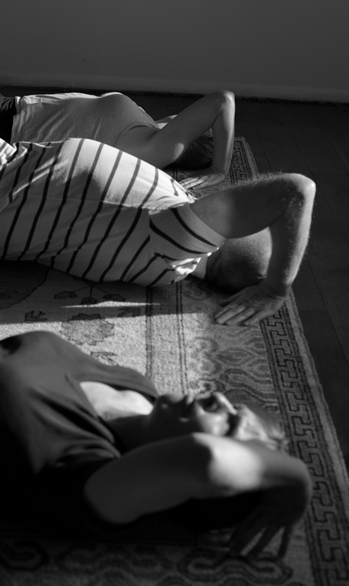
First and foremost, Feldenkrais is not an exercise: it is cleverly applied neuroscience.
The method, founded by Moshe Feldenkrais, is well established with thousands of practitioners worldwide. Good summaries of the method can be found at, for example, Wikipedia and the New Zealand Feldenkrais Guild. Fine summaries of the method include this article by Dennis Leri, and this talk by Jacek Paszkowski. Other useful articles are here and here. And if you understand Italian or don't mind subtitles, try this.
The many other web pages on the method are of varying quality, so I recommend reading the literature on the subject: a summary is kindly provided by Amazon's Quick to look inside feature on, for starters, and Feldenkrais's Awareness through movement, and Wildman's Busy person's guide to easier movement.
Many tube clips relating to the Feldenkrais Method including group classes (known as awareness through movement) - albeit of varying quality and relevance - are available at YouTube. These might give you an indication of what's involved in a group class, and the huge variety of class lessons.
A personal favourite is a video advertising the Alexander technique, the first seven minutes of which is an excellent introduction to how the way we hold and use our selves deteriorates over time. In my view (I've tried both), Feldenkrais is a much more effective (and interesting) method to strip away those bad habits and reset your self, but see at least the first seven minutes of this video. And here is a shorter classic: how we learned to move as infants is, fundamentally, how we need to re-learn to move effortlessly as adults.
It is difficult to describe the Feldenkrais Method uniquely and concisely, because there are so many dimensions or facets to it. So here's one:

Where have our necks gone?
The spine has 7 cervical (the neck), 12 thoracic (the chest or rib-cage) and 5 lumbar (lower back) vertebrae. While the relative lengths of limbs to spine can vary greatly between individuals, the relative lengths of these spinal sections are fairly uniform (at around 2:5:3). And yet, when we see others (or reflections of ourselves) from the front, some appear to have a long neck, and some no neck at all. The reasons are two-fold: we (well, nearly all of us) carry our heads too low, and our shoulders too high. Given that the cervical vertebrae of the neck are of fixed length, the only way we can carry our head too low is to carry it too far forward. This of course is what so many of us do in modern times, from straining to look at the screen, and slumping into armchairs. (We rarely see ourselves side-on: I recommend that scary experiment, with a camera, or with a large mirror to your side and a small mirror angled in front). With a head forward rather than supported above the spine, it has to be held up by the musculature of neck and back - no wonder that's where we get sore. And muscles cannot push, they can only pull: when we hold our shoulder blades high, they are being pulled up by muscles attached to the head, reinforcing the problem. It's not a state of affairs that we can consciously remedy, as we can only consciously control the large external muscles. How to re-active the core, internal muscles to do their job properly, hold the head free and release us of the burden? The Feldenkrais Method.
But all said and done, the Feldenkrais Method is experiential - you have to experience it to appreciate it. My best advice: try it. It's changed my experience of life in ways that I literally could not image before.
The Feldenkrais Method has two modalities:
- Awareness Through Movement® (ATM), group classes where verbal instructions are given to a number of students
- Functional Integration® (FI), individual sessions involving a combination of gentle, non-invasive touching and customised verbal instructions